Figured ostraka at
the Petrie Museum
The page was last modified on April 19th 2008
Sources:
1. Museum's web site
2. Page, Anthea: Ancient Egyptian figured ostraca : in the Petrie collection
Warminster : Aris & Phillips, 1983.
3. Shaw, Ian, Nicholson, Paul: British Museum dictionary of ancient
EgyptLondon: British Museum Press, 1995.
4. Brunner, Emma : Egyptian artists' sketches : figured ostraka from the
Gayer-Anderson collection in the Fitzwilliam Museum, Cambridge.
5. Janssen, Rosalind and Janssen, Jac. J.: Egyptian household animals
Aylesbury : Shire Publications, 1989.
6. Wilkinson, R. H. : The complete gods and goddesses of Ancient Egypt.
London : Thames & Hudson, 2003.
7. Calverley, A.: The temple of King Sethos I at Abydos, vol. IV. Chicago,
1958, pl. 18
8. My own study and observation of the ostraka listed
Back to Petrie
Back to top
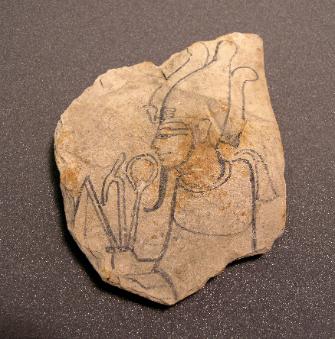
There is a suggestion (in: Calverley, A.: The temple of King Sethos I at Abydos, vol. IV. Chicago,
1958, pl. 18) that, the large aquiline nose suggests it is a portrait of Seti I, Ramesses II or
Merneptah, all of whom were portrayed with such a nose, in contrast to the straight noses of the 18th
dynasty predecessors. For this reason it was suggested that the ostrakon could be a student copy from
a temple relief or from a painting from the temple of Seti I at Abydos.
The figure wears a false beard. His garment is tight fitting and has a narrow collar. His hands are
holding three objects: the closest one to the figure is "hk3" sceptre - the crook symbolizing the
government, the middle one is "w3s" sceptre - whose primarily function in funerary context was to
ensure the continued welfare of the deceased, and the flail or "nekhakha" on the left. All three of
them are prominent items in royal regalia. Before the flail became part of royal regalia, it was
associated primarily with the god Osiris.
UC33190
Sekhmet and a worshipping figure
New Kingdom, around 1550-1350 BC
Possibly from Deir el-Medina
Limestone (more dense)
Red pigment
Standing figure of the goddess Sekhmet, who is
depicted as a lion-headed woman, with a sun disc
and uraeus on her head. Her face is turned to the
right towards a worshipping figure in a elaborate
pleated gown, typical of the late New Kingdom. The
worshippers hands are in a gesture of adoration.
Sekhmet wears tight fitting dress with straps over
her shoulder. She holds a staff or sceptre in her
left hand.
Height: 13.6 cm
Width: 11.7 cm
UC33249
Horus
New Kingdom
Possibly from Deir el-Medina
Limestone
Drawing of a falcon depicting the god Horus facing
to the right and standing on a  base line. There
are traces of a crown on his head and a flail, the
royal insignia, at his side. Three serpents stand
in front of him. Black pigment
Height: 10 cm
Width: 12 cm
UC33260
King making offering to Min-Amun
Possibly from Deir el-Medina or Koptos
19th dynasty of later date - possibly Ptolemaic
Limestone
Drawing of a king making an offering of two pots to
Min-Amun. The king wears the red crown (deshret) of
Lower Egypt and a short skirt with pleats and a
central panel. Min-Amun stands on the right on a
podium with a sloping front. He is represented in
mummiform. His figure is faint, while the figure of
the king and the podium underneath Min-Amun's feet
are coloured in. Between the two figures there is an
offering table with a cup and possibly two bull's heads
on it.
There are two vertical columns of hieroglyphic
inscriptions at the top, reading Min-Amun, Mn. The
horizontal line at the bottom reads "htp-di-nsw
Mn-Imn", meaning "The offering which the king gives
to Min-Amun".  
Red pigment
The style of the drawing shows signs of Ptolemaic
style. It could originate from Koptos, where the local
fertility god Min was worshipped and where Flinders
Petrie excavated the temple of Min.
Height: 18.7 cm
Width: 16.8 cm
The collection of figured ostraka at the Petrie Museum mostly comes from Flinders Petrie purchases.
The places of origin of these ostraka were not recorded and are still to be researched. The fact, that
most of them are just drawings lacking inscriptions, means that it is  more difficult to establish their
place of origin, than it is for the hieratic ostraka, where the names of people involved in transactions
are recorded and might be known to us from other sources. But most figured ostraka are probably from
Thebes, specifically from Deir el-Medina, or from places, where the Deir el-Medina artisans worked.
Possible future analysis and study of the limestone structure could help in locating more accurately their
places of origin.
The collection consists of drawings in black, or in black and red mineral based pigments, on small pieces
of limestone or terracotta sherds. They illustrate every stage from an apprentice's first attempts to
the most elaborate draughtsmanship. Some ostraka show the underlying sketch in red ink. Themes of
the ostraka vary from gods and royal personages to ordinary men and women, animals represented by
mammals, birds, insect and reptiles and even architectural and furniture elements, boats and individual
hieroglyphs.
Some ostraka were clearly the practise pieces of pupils, whose work was corrected by their teachers,
allowing us to learn something of their techniques. Some ostraka were products of the moment and
often bear themes and motives that do not appear in official art. They are unique treasures of original
works of art. As freedom is allowed to the artist, these glimpses illustrate fascinating aspects of the
ancient Egyptian culture and life.
I would like to express my thanks to the Petrie Museum and its staff, whose time and help has been
essential. The curator Stephen Quirke kindly gave me permission to publish the ostraka images on  my
web site, Tracey Golding and Ivor Pridden have been generous with their time and assistance.
UC33192
Ptah
Ramesside Period
Limestone
Figure of a seated god Ptah facing right. He wears a
tight fitting cap, with his large ears protruding, and a
long false beard which curls up towards the end. His
cloak is also tight fitting. It has got a collar from
which a tassel hangs. Both hands, placed one above the
other, hold a
dd-pillar and was-sceptre. The top of
the seat is depicted.
Black pigment with traces of underlying sketch in red
pigment
Height: 11.1 cm
Width: 7.8 cm
UC33256
Osiris
New Kingdom
Limestone
Figure of a seated god Osiris facing to the right.
He wear the atef crown and a false beard, a divine
attribute of the gods. He sits on a throne, which
stands on a raised platform. Behind the figure of
Osiris, there is the "imiut" fetish, consisting of a
decapitated animal skin hanging at the top of a pole,
which is a symbol of Anubis, who is associated with
the mummification process linked to Osiris.
At the right top corner there are three columns of
a hieroglyphic inscription.
Black pigment
Height: 9.2 cm
Width: 11.3 cm
UC33196
Thoth
New Kingdom
Terracotta
Red pigment
The upper part of the god Thoth depicted as an
ibis-headed man. He stands inside a shrine and
faces to the right. His head is drawn as a profile,
his upper torso is drawn from the front. He wears
a moon and disc on his head. His left hand holds
"w3s" sceptre. There are very faint traces of an
hieroglyphic inscription - 3 columns to the right of
the figure and 2 columns behind him. The
inscription was scraped off in the past and cannot
be read.
Height: 10.1 cm
Width: 9.7 cm
UC33224
Ram
New Kingdom, 1550-1350 BC
Black pigment
Terracotta
Drawing of a ram facing to the right. He has
got long horizontal horns on his head. There is
a faint base line and two horizontal lines, one
behind the ram, the other one, shorter, at
the top of his head, starting in the middle of
the horns. It was suggested that the line
might represent uraeus.
The drawing might be a representation of the
god Khnum.
Height: 6.8 cm
Width: 8 cm
UC33221
Upper part of Osiris or a king
19th dynasty (?)
Possibly from Deir el-Medina or Abydos
Limestone
Black pigment
Height: 11.7 cm
Width: 9 cm
Upper part of a king or Osiris facing to the
left. The figure wears the Atef crown
(effectively a "white crown" with plume on
either side). A large uraeus is attached to the
crown. His eye is drawn frontally, the eyebrow
and the cosmetic line are extended across the
temple parallely. Both the ear and the nose are
large.
UC33195
Ptah
New Kingdom
Limestone
Black ink
Figure of a standing god Ptah facing right. He is
placed within a shrine. The sloping pedestal on which
the god stands may represent the mound of creation
or the craftsman's level and the hieroglyphic symbol
for truth (maat). He is depicted as a mummiform
figure with his feet together and with his hands
protruding from his tightly wrapped shroud. He holds
the `nh-sign in his right hand, and w3s-sceptre and
dd-pillar in his left hand. He wears a close fitting
skull cap. His beard is straight rather than the usual
curved divine beard found on other Egyptian gods. He
wears a large tassel at the rear of his garment.
The god Ptah's original cultic association seems to
have been with craftsmen. He was revered at Deir
el-Medina.
Height: 13.1 cm
Width: 10.1 cm
UC33225
Amun
New Kingdom
Limestone
Black ink
head of a ram probably representing the
god Amun. He is facing right. His large
horns curve around his ears. He has got
a serpent drawn on top of his head.
Height: 7 cm
Width: 7.7 cm
UC33229
Jackal lying on winged disk
New Kingdom
Terracotta
Black ink
Drawing of a jackal lying on top of a large pair of
wings with solar disk and uraeus, facing right.
The wings of a hawk are symbolizing Horus. Since
Horus was associated with the king, the winged
disk  came to have both royal and protective
significance, as well as representing the heavens
through which the sun moved.
Height: 11.3 cm
Width: 10.4 cm
UC33226
Ram
New Kingdom
Black ink
Terracotta
Drawing of the head and the forepart of a
kneeling ram facing right. It has got long
wavy horns. There are traces of faint
hieratic inscriptions, perhaps reading as "may
you be divine in..."
Height: 5.2 cm
Width: 8.4 cm
UC33191
Thoth
New Kingdom
Limestone
Black ink
The upper part of a standing figure of the god
Thoth who is depicted as an ibis-headed man
facing right. The lunar disk and crescent on his
head symbolize the moon's phases. He wears a
tripartite wig. His shoulders are drawn
frontally. He wears a short skirt with a broad
band across his body and over his left shoulder.
Height: 18.7 cm
Width: 10.6 cm
UC33812
Meretseger
New Kingdom, 1550-1350 BC
Possibly from Deir el-Medina
Limestone
Black ink
Drawing of a serpent - a rearing cobra - in front of
an offering table/vase/metal stand. The hood of the
cobra is dilated and patterned. The base line is
indicated.
Meretseger was the goddess of the pyramidal peak
which lies above the Theban necropolis. Her usual
name was "she who loves silence". She was primarily
worshipped by the workmen of Deir el-Medina.
The stand resembles metal stands for vases found
in Theban tombs. This form of stand appears on
coffins, generally under the offering table depiction.
Height: 7.3 cm
Width: 9.4 cm
UC33258
Queen Ahmose-Nefertari
Possibly from Deir el-Medina
19th dynasty, 1295-1186 BC
Limestone
Black ink with traces of the preliminary sketch in red
Upper part of a figure of Queen Ahmose-Nefertari
facing left. She wears a long tripartite wig and the
Vulture headdress.
Dating of the ostrakon takes into consideration the
fact that Queen Ahmose-Nefertari was represented
as wearing the "Vulture" headdress after she was
deified in the Ramesside Period.
Height: 11.8 cm
Width: 13.5 cm
Ostraka displaying motives of deities
UC33244
Head of a man
New Kingdom, 1550-1350 BC
Possibly from Deir el-Medina
Limestone
Black ink and red pigment
Head of a balding man drawn in profile facing left. He
wears a collar with lines radiating from his neck. His facial
features are no longer visible. It is possible that this is a
trial piece for a painting in a Theban tomb, representing a
member of a family or a deceased person. The areas
around the eye and the mouth could have been erased as
the red wash used for the face and the top of the head
seems to be missing there.
Height: 10.3 cm
Width: 9.5 cm
UC15947
Head of a noble
20th dynasty? (1186-1069 BC)
From Thebes. Left behind by students of a school of
ancient artists in Ramesseum's mud brick magazines.
Marked "Petrie 2" on its label.
Terracotta
Black ink
Head and shoulders of a noble drawn in profile facing left.
He wears a short wig brought behind his ears. He has got
a short square beard. His eye is drawn frontally. The line
of his nose is similar to profiles on portraits of the
Ramesside kings.
This is probably a trial piece for paintings in royal tombs
or tombs of private individuals from the Theban necropolis.
Height:  8.8 cm
Width:  7.6 cm
UC33237
Standing man
New Kingdom, 1550-1350 BC
Terracotta
Black ink
Drawing of a standing figure of a headless man facing
right. He wears a wraparound short kilt. His left leg
is drawn advanced, his right arm is held across his
chest in an upright position, his left arm is down
holding a long object, possibly a bouquet as an
offering. This ostrakon might be a trial piece for a
painting in an offering scene on a tomb wall.  
Treated at the Institute of Archaeology.
Height:  12.7 cm
Width:  11.1 cm
UC33227
Pintail duck
19th dynasty?
Marked from Deir el-Bahari on the back
Limestone
Black ink
Drawing of a pintail duck in flight facing right. The body
and wings are drawn in outline, the head is filled in with
black ink.
Pintail ducks were the most common kind of duck in ancient
Egypt. They were very frequently depicted on temple and
tomb walls. When depicted in flight they are also a
hieroglyphic sign representing the ideogram "pa" meaning
"to fly". The drawing could be a trial piece of a hieroglyph,
but equally it can be a trial piece for a larger scene.  
Height:  10 cm
Width:  5.6 cm
UC33216
Head of an owl
New Kingdom, 1550-1350 BC
Possibly Deir el-Medina
Terracotta
Black ink
Frontal drawing of a head of an owl, which most
probably represents an artist's study of a
hieroglyphic sign "m". There are several more
drawings representing hieroglyphs - a loaf of
bread at the left top corner representing phonetic
"t", the back of a viper representing "f" and a
part of a feather representing "sw".
Height:  5.3 cm
Width:  5.7 cm
UC33207
Goose
New Kingdom, 1550-1350 BC
Possibly from Deir el-Medina
Limestone
Red pigment
Outline sketch of a goose facing right. Its neck is
extended and its head is bent to the ground as if
pecking the ground. The base line is indicated.
The goose was frequently depicted on temple and
tomb walls. It is also a hieroglyphic sign for
semi-phonetic "gb" and determinative for
"gb"-goose. This could have been a preliminary
sketch as a draft for an agricultural scene.  
Height:  10.1 cm
Width:  12.8 cm
Ostraka displaying motives of royal figures
Ostraka displaying motives of men
Ostraka displaying motives of birds
UC33210
Torso of a king
New Kingdom, Ramesside Period, 1295-1069 BC
Limestone
Drawing in black ink, there are traces of red pigment on the
crown and in front of the figure
Drawing of the upper part of a king's torso. He faces to the
right, his right arm is raised horizontally at the shoulder
level, perhaps in the gesture of making an offering. His eye
and shoulders are drawn frontally. He wears an elaborate
composite crown, consisting of White crown, flanked by twin
plumes, sitting on top of the Red crown, encircled by uraei
with disks on their foreheads. The whole Double Crown, which
could also be seen as Atef Crown, is flanked with horizontal
pair of ram's horns. They end in large uraei, surmounted with
sun disks. The king's head is also adorned with a short wig,
uraeus on his forehead and a false beard on his chin. He
wears a broad collar and a pleated skirt with a wide pleated
tie around his waist and over his shoulder.  
The drawing is skillfully executed and could be a student copy
of a temple relief or a craftsman's draft for a temple relief.
Height: 13.6 cm
Width: 9 cm
UC33239
Seated man before an offering table
New Kingdom, 1550-1350 BC
Possibly from Deir el-Medina
Limestone
Black ink
Drawing of a seated man in front of an offering table. He
sits on a low-backed, block throne and faces right. The
small table before him is laden with food offerings: conical
and round loaves of bread and birds. Behind the seated
man stands another figure. Above the figures there is an
wd3t-eye, probably one of a pair, as the surface of the
whole right top corner is flaked off. Beneath the base line
of the drawing there are traces of another unidentified
drawing.
The drawing represents a typical funerary offering scene
with the deceased seated and his relative in attendance.
Perhaps this is a miniature stela, that could have come
from a workmen's tomb at Deir el-Medina.
Height:  7.2 cm
Width:  6 cm
UC33238
Kneeling man
New Kingdom, 1550-1350 BC
Possibly from Deir el-Medina
Terracotta
Black ink
Drawing of a headless kneeling man facing to the
left. He kneels on his left leg and sits on the heel
of his foot. His right leg is drawn up towards his
body. He faces an offering table bearing four
circular loaves of bread and a lotus flower. The
man wears a wide-sleeved garment. His arms are
raised in adoration. There could have been a figure
of a deity behind the offering table, the remaining
line could be the god's leg. The base line is
indicated.
Marked in black ink "o" below the base line.
This type of scene frequently appears on Deir
el-Medina votive stelae and in the tomb
decoration. If the line of the leg are remains of a
mummiform god, both Osiris and Ptah could have
stood behind the offering table.
Height:  11.3 cm
Width:  13 cm
UC33214 front
Two men walking
New Kingdom, 1550-1350 BC
Limestone
Black ink, traces of red pigment on upper
arm of the man on the right and in the
bottom right corner of the ostrakon
Drawing on a squared-off piece of a
limestone of two men walking facing right,
holding staffs in their left hands. Both
wear short pleated skirts.
UC33214 back
One line of a vertical cursive inscription
The 1st sign reads
ht, the 2nd and the 5th are
probably the same hieroglyph representing the male
figure. The 3rd sign is damaged, the 4th is not
decipherable. The last sign is the sun-disk.
The inscription can be interpreted as a name, the
possible readings could be
Ra-khet or Khet-su.
Height:  6 cm
Width:  7.3 cm
UC2227
Man carrying bundles
20th dynasty, 1186-1069 BC
Found at Thebes in the brick chamber north of the pylon of
Tuthmosis IV
Terracotta
Black ink
Drawing of a man, possibly a peasant, carrying a bundle in his
right hand at his side and another one on a long stick held over
his shoulder with his left hand. He walks towards the right,
his left leg is advanced. His head is drawn in profile. His hair
is straight. He wears a short skirt tied around his waist and a
short-sleeved top.
Height:  21.3 cm
Width:  18.5 cm
UC33223
Standing girl
Ramesside period, 1295-1069 BC
Limestone
Black ink
Drawing of a standing girl facing right. She wears a
sidelock of youth and a diaphanous gown. Her legs and
body are well rounded. Her pubic triangle is indicated. Her
left hand is raised to her forehead, and holds a cup in her
right hand.
Height:  12.4 cm
Width:  10.8 cm
Wennekhu's stela.
British Museum
EA 1248.
An example of a
Deir el-Medina
stela showing the
same position of
adoration.
UC33202
Man and bull
New Kingdom, 1550-1350 BC
Limestone
Red and black pigment
Drawing of a pied bull, whose head is missing, walking
to the right, followed by a herdsman with a feather
on his head. The man, who is disproportionately small,
holds a stick in his right hand and a piece of rope over
the left arm. He wears a short kilt. The base line is
indicated.
Traces of red pigment from the preliminary sketch,
also there is red pigment on bull's patches.
The surface of the ostrakon is very fragile and
fragmentary. It has been treated in the Institute of
Archaeology.
Height:  8.8 cm
Width:  9.4 cm
Ostraka displaying motives of women
UC33230
Curlew
New Kingdom, 1550-1350 BC
Terracotta
Black pigment
Drawing of a curlew standing and facing right. It
has a long narrow beak, large round eye and thin
legs. The feathers are marked with streaks.
The drawing can be identified with a Senegal
stone curlew, which is resident in both Delta and
Upper Egypt.
It could be a draft for one of the numerous
scenes in the marshes found on the walls of the
Theban tombs.
Height:  13.9 cm
Length:  13.7 cm
UC33222
Vulture
Possibly Ramesside Period, 1295-1069 BC
Limestone
Black pigment
Drawing of a vulture facing right with its neck
stretched out, head down and a pair of large wings
slightly open. The bird is holding its prey with its
leg and beak. The outline of the vulture is drawn
in black ink, the prey is filled in with
reddish-brown wash, perhaps to imitate blood.
The bird can be identified with the Griffin
Vulture. Vultures were common as hieroglyphic
signs: determinative for
nrt (vulture), and a
phonetic value for
Mt. It also represented the
goddess Nekhbet of El-Kab.
Height:  9.8 cm
Length:  11.8 cm
Ostraka displaying motives of mammals
UC33200
Fighting bulls
New Kingdom, 1550-1350 BC
Limestone
Black pigment
Drawing of two bulls facing each other.
Their heads are down and their horns
are interlocked. The ground is indicated
by a line. Above the bull on the right
side, there is a man facing left, striding
out, his right arm raised. He wears a
short kilt. His head is missing.
Height:  13.1 cm
Width:  16 cm
UC33209
Leaping bull and a duck
Late 18th dynasty, Amarna Period
Terracotta
Black ink
Lively drawing of a young bull leaping towards
the right. A pintail duck is flying above, also
facing to the right.
Similar motives were found at palaces at
Amarna and at Malqata.  
Height:  6.1 cm
Width:  12 cm
UC33199
Bull-god?
Limestone
Black ink
The bull is standing and facing right.
There is a sun-disk between his horns.
The disk is drawn frontally. Smudged
beneath the body. The drawing is very
crude and it is difficult to establish
which bull-god is represented here.
Height:  11.3 cm
Width:  14.4 cm
UC33206
Head of a donkey and Amun
New Kingdom, 1550-1350 BC
Black ink
A drawing of a donkey's head facing left. One pair of
ears is long and pointed, then lower at the back of
the head there is another ear added. Below the
donkey's head there are several more motives: two
wide horizontal lines joined together by a herringbone
design, upper part of a figure of the god Amun with a
long beard and wearing the crown with double plumes
and holding a
w3s-sceptre. In front of the donkey
there is a fragment of a possible bowl, again with a
herringbone design.
The motives do not seem to be connected to each
other, possibly this is a trial piece, especially if taken
into consideration that several attempts have been
made with the ears. Donkeys were often depicted in
agricultural scenes on walls of the Theban tombs.
The herringbone design was used to show the veining
seen in travertine (Egyptian alabaster).
Height:  13.5 cm
Width:  13.9 cm
UC26937
Galloping horse
New Kingdom, dynasty 18th until dynasty
19th, 1550-1186 BC
Terracotta
Red and black pigment
Figure of a galloping horse, facing left. The
horse is painted with red pigment. The legs
of the animal are missing. Behind the horse
there is a drawing in black of part of a
chariot and reins that lead the horse.
Height:  10.7 cm
Width:  16.5 cm
UC33215
Lion
Possibly Ramesside Period
Limestone
Red and black pigment
Verso: drawing of a lion facing right, waiting to strike. He crouches on his front legs with
his head down. A ground line is indicated. Above the lion's body is the figure of a man with
his leg advanced and his arms raised as if in a hunting position.
Recto: drawing of a lion striding out towards right, with his head up and his mouth open.
We possess evidence that lions were tamed in ancient Egypt. New Kingdom pharaohs are
often shown in the company of a docile lion. They are portrayed lying beside the throne or
running along the royal horses and chariots. These scenes might bear symbolic significance
and emphasise the strength of the king, but the evidence shows lions were serviceable
creatures to the ancient Egyptians.
Height:  16.1 cm
Width:  12.3 cm
Ostraka displaying motives of beetles and insects
UC35811
Scarab beetle and hieroglyphs
New Kingdom, 1550-1350 BC
Limestone
Black ink
Drawing of the top of a scarab beetle (
Scarabeus
sacer
) with its body, legs and head competently
drawn. A vertical column of hieroglyphs runs down
the right side of the ostrakon. The inscription
reads:
(ntr) nfr nb t3wy nb ir ht = Good (god),
lord of the two lands, lord who makes everything
Height:  7.1 cm
Width:  5.3 cm
UC33231
Wasp and grasshoppers
New Kingdom, 1550-1350 BC
Limestone
Red pigment
Verso: drawing in red pigment of a wasp on the left and a grasshopper on the right. The
left image is drawn in greater detail. The body is striped, there are four legs with
feet, long antennae, and a pair of wings. The image of the grasshopper is fainter and
more schematically drawn. Only the body and the long bent leg are depicted.
Recto: a drawing of another grasshopper in red pigment. Again schematically drawn with
antennae, long bent leg and the long closed wings.
Height:  16.4 cm
Width:  13.1 cm